A CCTV drain survey puts a camera through the underground pipes of a property to check their condition and gives you a written report. A normal home survey only looks briefly at what else it can see and does not investigate drainage installations, so hidden damage or blockages are unlikely to be picked up. Typical pre-purchase prices for a standard property are around £250 to £350.
What a CCTV drain survey is
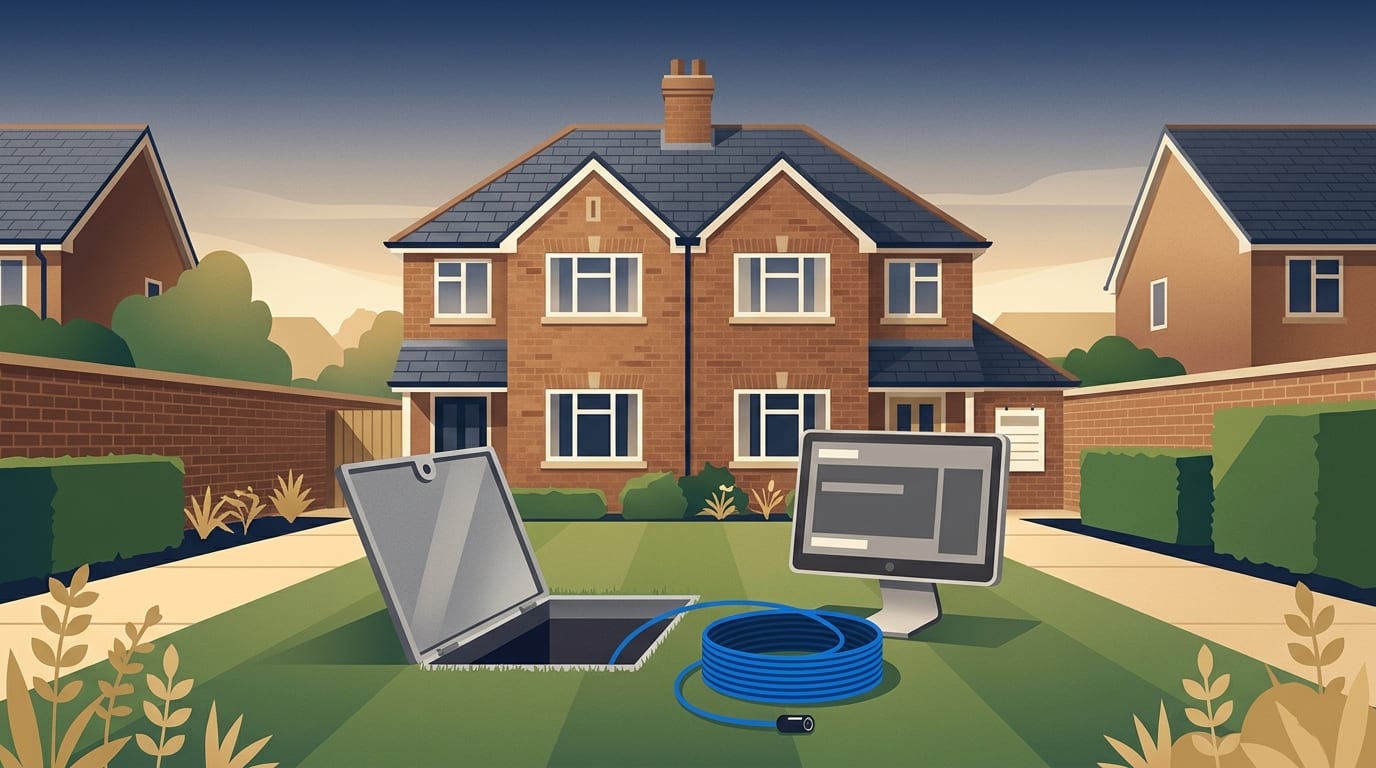
A CCTV drain survey is a specialist inspection carried out by a drainage contractor. The engineer feeds a camera through the drainage network to look for cracks, root damage, collapses and blockages. They review the live footage on a screen to identify problems that are completely hidden from the surface.
Drain problems may not be immediately apparent and can take months to surface after you move in. Buyers are generally advised to seek a specialist's guidance, and blocked drains could cost as much to repair as structural problems. A drain survey gives an assessment and a record of the condition of the pipes the camera can reach.
The engineer reviews live footage as the camera moves through the pipes. Afterwards you should receive a written report with footage, images and a site plan.
Why a home survey does not cover the drains
The main purpose of a building survey is to ensure the structural and foundational integrity of the house. Surveyors will briefly examine what else they can see, but they may not go into any depth.
Home surveys follow three RICS levels. Level 1 describes condition, flags risks and urgent defects, and suits conventional, newer homes in good condition. Level 2, still widely called a HomeBuyer Report, suits conventional homes in reasonable condition. It is a visual, non-intrusive inspection. Level 3, still widely called a building survey or full structural survey, is the most detailed and suits older, larger, altered, unusual or run-down homes. Reports use condition ratings shown as traffic lights.
According to the official rules, standard RICS Level 2 and Level 3 home surveys do not investigate plumbing, heating or drainage installations. The Level 2 survey also does not inspect drains in flats. A mortgage valuation is not a survey either, as it is a limited check for the lender's benefit.
A CCTV drain survey is a drainage contractor job and is not usually done by the home surveyor. If you want to know if the underground pipes are broken, you need to book a separate drain survey. Your home surveyor may recommend further investigation of the drains in the report. If you want to know about the general condition of the building first, you can look at typical house survey costs.
When buyers should get one
You do not automatically need a drain survey for every house purchase, but there are clear times when it becomes a sensible investment. A drain survey makes most sense when your home surveyor recommends further investigation of the drains, or when the property has risk factors such as older pipework or a private drainage system.
If you are buying a property with an off-mains drainage system, getting the system checked is a sensible precaution. With an off-mains system the homeowner alone is responsible for maintenance and upkeep. A history of blockages or slow draining water mentioned by the seller is another strong reason to investigate further.
You should book the drain survey alongside your main house survey so the results arrive well before you exchange contracts. You are spending a large sum of money against a deadline, with estate agents, lenders and conveyancers all expecting progress. A bad survey finding could alter the deal, so you need the detail as early as possible.
You will need to ask the seller for access in advance, as the drainage contractor will need to walk around the property and open the manhole covers. It is an entirely separate job from your building survey, so you must arrange it directly with a drainage company.
What the survey involves
Setting up the equipment
The drainage contractor will arrive with all their inspection tools. Before the survey begins, the surveyor locates the manholes and access points around the property. They will then set up their equipment, which might include cameras, access rods and crawlers.
Inspecting the pipework
During the inspection, the camera is fed through the pipework. The engineer reviews the live footage on a monitor and notes any defects as the camera moves along the drain. They will record the location and severity of any cracks, displaced joints, root intrusions or blockages they encounter.
Reporting the results
After the physical inspection is finished, the surveyor reports their findings and the next steps. They provide a written report that details the condition of each section of the drainage system. This allows you to see exactly what is working well and what needs urgent attention.
What the report should tell you
A professional drain survey report provides a clear view of a hidden system. It gives you an assessment of the drains the camera reaches before you sign any legally binding contracts, although no drain survey can promise to find every fault. The report indicates the condition of the drainage system and exactly which parts are the homeowner's responsibility.
A complete CCTV drain survey package will include:
- A written summary of the overall condition of the drains
- A site plan mapping out where the pipes run
- Details of any defects found and where they are located
- Recommendations for repairs or maintenance and the next steps
- Video footage and still images taken by the camera
- An indication of which parts of the system are your responsibility
You should give a copy of this report to your conveyancer as soon as you receive it. They can use it when checking which parts of the drainage are the homeowner's responsibility.
What a CCTV drain survey costs
A CCTV drain survey costs between £90 and £500, with an average price of £250. The exact price depends on the level of detail you need, the type of equipment used and the size of the property.
For a purchase, the pre-purchase rows in the table are the closest match rather than a basic blockage check. The table below shows typical prices for different types of drainage investigation.
The figures in the table are typical published prices for 2026.
|
Type of job |
Typical price |
|---|---|
|
Basic blockage survey |
£90 |
|
Basic drain and sewer inspection |
£150 |
|
Locating blockages with CCTV |
£250 |
|
Pre-purchase survey for a standard property |
£250 to £350 |
|
Pre-purchase survey for a larger property |
£350 to £450 |
|
Full survey with drain mapping |
£350 |
|
Full survey with robotic crawler |
£350 |
|
Full survey with push camera |
£500 |
The actual quotes you receive from local drainage companies will differ based on your location and the specifics of the property you are buying.
By comparison, typical 2026 ranges for standard home surveys are roughly £300 to £450 for a Level 1 survey, £400 to £950 for a Level 2 survey and £600 to £1,500 or more for a Level 3 survey. You will need to budget for both the building survey and the drainage survey if you want a complete picture of the property.
What pushes the price up
Cleaning and clearing blockages
The condition of the pipes before the camera goes in can affect the final price. If the drain is badly blocked, the engineer cannot see the walls of the pipe to inspect them. Pre-survey cleaning and jetting is then needed to clear the way, which typically adds £100 to £150 extra to the bill.
Difficult access
Ease of access is another major factor that can increase the cost. If the engineer cannot easily locate the drain entrance, or if excavation is required to get to the pipes, this can add £100 to £300 to the total. The number of access points around the property will also dictate how much time the engineer spends on site.
Property size and location
The property type and the overall drain length play a large part in the price. Larger properties simply take longer to map and inspect, which is reflected in the higher starting price. Properties located in London and the South East often attract higher rates than those in other parts of the country, and emergency surveys may carry an additional call-out fee.
Who is responsible for which drain
Mains drainage connections
When a drain survey finds a problem, the first question is who has to pay to fix it. On a mains connection, the homeowner is generally responsible for the section of pipework within the property boundaries. The water and sewage company is responsible for the pipes beyond the property line.
Off-mains drainage systems
With an off-mains system such as a septic tank, the homeowner alone is responsible for maintenance and upkeep. If you are buying a property with a private system, a drain survey is worth considering because the homeowner alone is responsible for its maintenance and upkeep.
Your drain survey report will help clarify the layout of the system. It indicates the condition of the drainage system and which parts are the homeowner's responsibility. Your conveyancer can use this information when advising you on responsibility for the drains.
Problems found before you exchange
If your drain survey reveals broken pipes or severe blockages, you have several options. Before you exchange contracts, you can use the findings to decide whether to proceed, renegotiate the price or walk away entirely.
Your first step is to get quotes for the necessary repairs from a drainage contractor. Do not try to guess the repair costs, as excavating and replacing deep pipes can be highly expensive. Give the survey report and the repair quotes to your conveyancer, who can discuss the issue with the seller's legal team.
You can ask the seller to fix the drains before completion, or ask them to reduce the house price by the cost of the repairs. Your conveyancer can advise on how to raise the findings with the seller. Make sure you act quickly and keep your conveyancer informed so you do not delay the exchange of contracts.
Common questions
What is the drain survey price for a basic check?
A basic blockage survey starts at £90, while a basic drain and sewer inspection costs around £150. These basic checks are not the same as a pre-purchase survey. A full pre-purchase survey for a standard property, which includes mapping and a detailed report, will usually cost £250 to £350.
Will the survey find every fault?
A CCTV survey records the inside of the pipes it can reach, but it cannot promise to find every fault or give a clean bill of health. It cannot inspect pipes that are completely inaccessible or hidden behind solid blockages until those blockages are cleared. It is a visual inspection of the inside of the pipes only.
Can the home surveyor check the drains?
Not usually. A building surveyor checks the structure of the house, and CCTV drain surveys are normally done by a drainage contractor. Standard home surveys do not investigate drainage installations. A drain survey is a separate job carried out by a specialist drainage contractor.
What is a drainage CCTV survey cost for larger homes?
A pre-purchase survey for a larger property typically costs between £350 and £450. Larger homes have a longer drain length and more access points, which means the engineer has to spend more time setting up equipment and mapping the network. If the property requires a full survey with a push camera, the price can reach £500.
What to do next
Booking a drain survey is a straightforward process, but timing is important. You want the results back with plenty of time to review them before you commit to the purchase. Under the Consumer Rights Act 2015, a service must be carried out with reasonable care and skill. Services arranged online or by phone normally carry a 14-day cooling-off period, but if you ask for the work to start inside it you pay for what has been done.
- Check your home survey report to see if the surveyor has recommended a specialist drainage inspection
- Ask the seller or estate agent for permission to have a drainage contractor visit the property
- Get two or three like-for-like quotes that state the level of inspection and turnaround time
- Make sure the quotes include a written report, a site plan and the camera footage
- Book the survey well before you plan to exchange contracts
- Send the final report and site plan to your conveyancer to check against the property boundaries
A drain survey provides a clear view of a hidden system that can be very costly to put right if it fails. If you are ready to arrange your standard property checks, you can compare quotes and find a surveyor near you.
Find a top rated surveyor near you
1,519 surveyors across the UK, each ranked on their Google rating and the number of reviews behind it. Start with your county: