Finding damp patches or mould on your walls during winter is a common problem. The four main types of damp are condensation, penetrating damp, rising damp and traumatic damp from leaks. According to official GOV.UK guidance, condensation is the most common form of damp found in residential properties. Because the causes of these four types often overlap, telling them apart is a job for a qualified person.
The wording here follows the GOV.UK guidance on understanding and addressing the health risks of damp and mould in the home, which was first published on 7 September 2023, was last updated on 1 April 2026 and applies to England.
Condensation or damp and why it matters
Identifying the exact type of dampness dictates the repair you need to make. Rising damp is often misdiagnosed, and treating the wrong problem leaves the root cause untouched.
It is tempting to wipe away the visible signs and hope the problem is solved. However, simply removing surface mould will not prevent the damp and mould from reappearing. You need to understand where the moisture is coming from and how it is behaving inside your home.
If you treat the wrong problem, the underlying defect will continue to damage your property. A qualified person can tell you which type, or types, of damp you have, and that is the sensible first step before any repair is paid for.
Condensation damp
Condensation damp happens when moisture generated inside the home cools and condenses onto colder parts of the buildings. This is an everyday physical process, but it becomes a serious problem when the moisture has nowhere to go. Warm air holds more water vapour than cold air, so when the indoor temperature drops, that trapped water is released onto the nearest cold surface.
You will typically notice the signs on specific colder surfaces around your rooms. These areas suffer because warm air struggles to circulate around them, leaving the surfaces significantly colder than the rest of the room. These include:
- Window frames
- The corners of rooms
- Low points on walls behind sofas
- Low points on walls behind wardrobes
The amount of water vapour in your home is driven by your daily routine. Showering, drying laundry and cooking are all common contributors that push large volumes of water into the indoor air. If a home is inadequately ventilated, this moisture in the air cannot escape outside and remains trapped inside the rooms.
The heating and insulation of your home also play a part. Poorly insulated or inadequately heated homes are more prone to condensation on internal walls and windows. Without consistent heating to keep the internal surfaces warm, or insulation to block the cold from outside, your walls act as a magnet for airborne moisture.
Penetrating damp
Penetrating damp is water that gets into the building from outside due to defects in the walls, roofs, windows or floors. Unlike condensation, which starts with moisture made inside the house, the water in penetrating damp comes from outside.
Finding the source takes a qualified person. The checks and building deficiencies GOV.UK names include:
- Broken seals around windows
- Cracks in render on external walls
- Missing or broken roof finishes
- Blocked gutters
- Defective roofs
- Faulty damp proof courses
Blocked gutters are named as one of the building deficiencies. Roofs and gutters are at height, so leave checking them to a qualified person.
Rising damp
Rising damp is moisture from the ground that rises up through parts of the buildings.
This specific type of dampness is usually found in older properties. Defective damp proof courses and membranes are named as a cause.
Rising damp is often misdiagnosed, so the diagnosis should come from a qualified person. Other types of damp can look similar on a lower wall.
GOV.UK describes rising damp as usually found in older properties and often misdiagnosed. A visual check alone is not the way to confirm it. Chemical testing is the most appropriate way of confirming it, so ask the surveyor how they will confirm it.
Damp from leaks and flooding
Traumatic damp is the term used for a sudden or continuous influx of water from a specific plumbing or environmental failure. Unlike the slow build up of condensation or rising ground water, traumatic damp introduces large volumes of water into the building fabric very quickly.
Everyday plumbing fixtures and hidden pipework are common sources. Traumatic damp can be caused by:
- Leaking water from waste pipes
- Leaking water from heating pipes
- Overflowing baths or sinks
- Burst pipes
- Outside sources such as environmental flooding
Waste and heating pipes are often hidden under floorboards or buried inside walls. This means a slow leak can go unseen for some time. If you suspect a leak, leave tracing it to a qualified person and do not lift floors or open walls to look for it.
Outside sources such as environmental flooding will also leave a property suffering from traumatic damp. A surveyor can say what the flooding has left behind.
Why the causes overlap
The table sums up where the moisture comes from in each of the four main types of damp.
|
Type of damp |
Where the moisture comes from |
|---|---|
|
Condensation |
Moisture made inside the home that cools and condenses on colder parts of the building |
|
Penetrating |
Water from outside through defects in the walls, roofs, windows or floors |
|
Rising |
Moisture from the ground that rises up through parts of the building |
|
Traumatic (leaks) |
Leaking waste or heating pipes, overflowing baths or sinks, burst pipes or flooding |
A property can have more than one type of damp at the same time. GOV.UK says there may be multiple causes. For example, traumatic or penetrating dampness may exacerbate condensation dampness which is the example GOV.UK gives.
When a wall is soaked by a leaking gutter or a faulty pipe, the wet masonry can become colder than the dry walls around it, which can make condensation more likely on that patch.
This layered effect makes it hard to tell where the fault lies from the visible mould alone.
According to GOV.UK guidance, landlords should not assume they will be able to diagnose the problem themselves in all instances. Property owners should use appropriately qualified contractors to investigate the damp, trace it back to its origin, and specify the correct fix.
How a surveyor tells them apart
When you hire a professional to investigate the problem, an inspection is always preferred over an assessment based on photos. Photos can show the extent of the mould, but they cannot reveal the temperature of the wall, the humidity in the room, or the condition of the external brickwork. A damp surveyor should be able to carry out a damp survey, identify the root cause of the issue, and identify which type of damp it is.
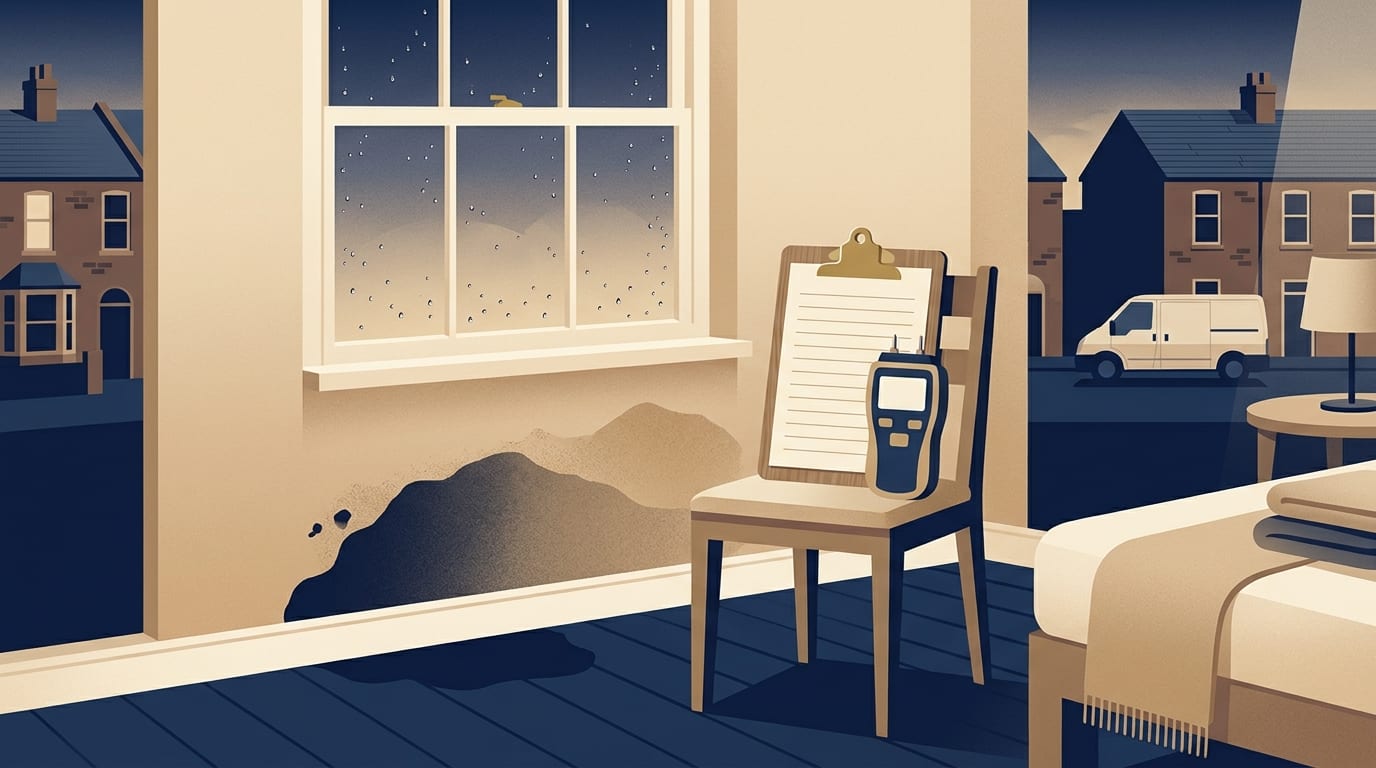
The surveyor will start with a series of internal checks. This includes taking readings of consistently high relative humidity using a moisture meter or environmental monitors. They will use the moisture meter to profile the dampness across the wall, checking whether the moisture is concentrated near the floor, around a window, or tracking down from the ceiling. You can read more about how to get an independent damp survey to understand what the inspection involves and how to hire a qualified professional.
Some damp problems are deeply hidden and require more advanced diagnostic tools. For complex cases, the surveyor might use thermography to map out the hidden cold spots behind the plaster. GOV.UK also mentions environmental monitoring and microbial sampling for complex cases.
Official guidance provides no numerical moisture thresholds, so no number can be quoted here. Instead the surveyor works from the readings and the inspection.
The surveyor will also rely on their senses to detect hidden problems. The smell of mould without visible evidence of mould may indicate that there is mould behind a surface, such as under the floorboards or behind fitted kitchen cabinets. Mention any such smell to the surveyor.
When to call a surveyor
GOV.UK says an inspection is preferred over an assessment based on photos, so a damp surveyor will usually want to see the property.
You should call a damp surveyor when the cause of the moisture is unclear, or when the problem persists despite your best efforts. If you have improved your heating, increased your ventilation, and the damp patches still return, you need a professional diagnosis. Guessing the cause risks paying for treatment that does not fit the problem.
If you are renting your home, tell your landlord when you spot damp patches or returning mould.
Simply removing surface mould will not prevent the damp and mould from reappearing, so the cause needs to be found. A damp surveyor can identify the root cause and which type of damp it is.
Common questions
Why do I have condensation on my walls?
Condensation forms when warm, moist air inside your home hits a cold surface. Showering, drying laundry and cooking add moisture to the air. If your home is inadequately ventilated, poorly insulated or inadequately heated, this moisture condenses on colder parts such as windows and internal walls.
Can penetrating damp cause condensation problems?
Yes, they can overlap in the same room. GOV.UK says traumatic or penetrating dampness may exacerbate condensation dampness.
How is rising damp confirmed?
Rising damp is often misdiagnosed. Chemical testing is the most appropriate way of confirming it. It is usually found in older properties with defective damp proof courses and membranes.
What does a musty smell mean if there is no mould?
You do not always need to see black patches on your walls to have a mould problem. The smell of mould without visible evidence of mould may indicate that there is mould hidden behind a surface. A surveyor can use environmental monitors and other methods to locate it.
Is condensation the most common type of damp?
GOV.UK calls condensation the most common form of damp. That does not make it the cause in your home, because there may be multiple causes and one type can make another worse.
Will removing surface mould stop it coming back?
No. GOV.UK says simply removing surface mould will not prevent the damp and mould from reappearing, so the cause has to be found. That is a job for a damp surveyor, who can identify the root cause and which type of damp it is.
Can I diagnose damp myself?
GOV.UK says landlords should not assume they will be able to diagnose the problem themselves in all instances. If the cause is unclear, ask a qualified person to inspect, and do not open walls, drill or lift flooring to look.
Steps to take next
Finding the true cause of damp requires a logical approach. Follow these steps before you pay for any repair work:
- Note where and when the damp patches or mould appear.
- Look for signs of leaks around waste pipes, heating pipes and bathroom fittings.
- Improve your ventilation when showering, cooking or drying laundry to let moisture escape.
- Report any returning damp patches or hidden musty smells to your landlord if you rent your home.
- Hire a qualified damp surveyor to inspect the property if the root cause remains unclear.
If you need a professional diagnosis to tell you exactly what is causing the moisture, find a surveyor near you.
Find a top rated surveyor near you
1,519 surveyors across the UK, each ranked on their Google rating and the number of reviews behind it. Start with your county: