A flying freehold exists when part of one freehold property sits above or below land or a building owned by someone else. It matters when you buy a house mainly because mortgage lenders and conveyancers treat it with care. You can still buy and sell a property with this feature, but you must satisfy your lender that the right legal protections are in place.
What a flying freehold is and common examples
A flying freehold refers to freehold property built over land which does not form part of the property. When you buy a standard freehold house, you own the building and the ground it sits on. With a flying freehold, a section of your building overhangs or projects out from underneath a neighbouring property.
The 'flying' part need not be in mid-air. It simply means the structural element you own crosses the physical boundary line of the land you own. That can leave your property depending on another person's property for support.
Examples include:
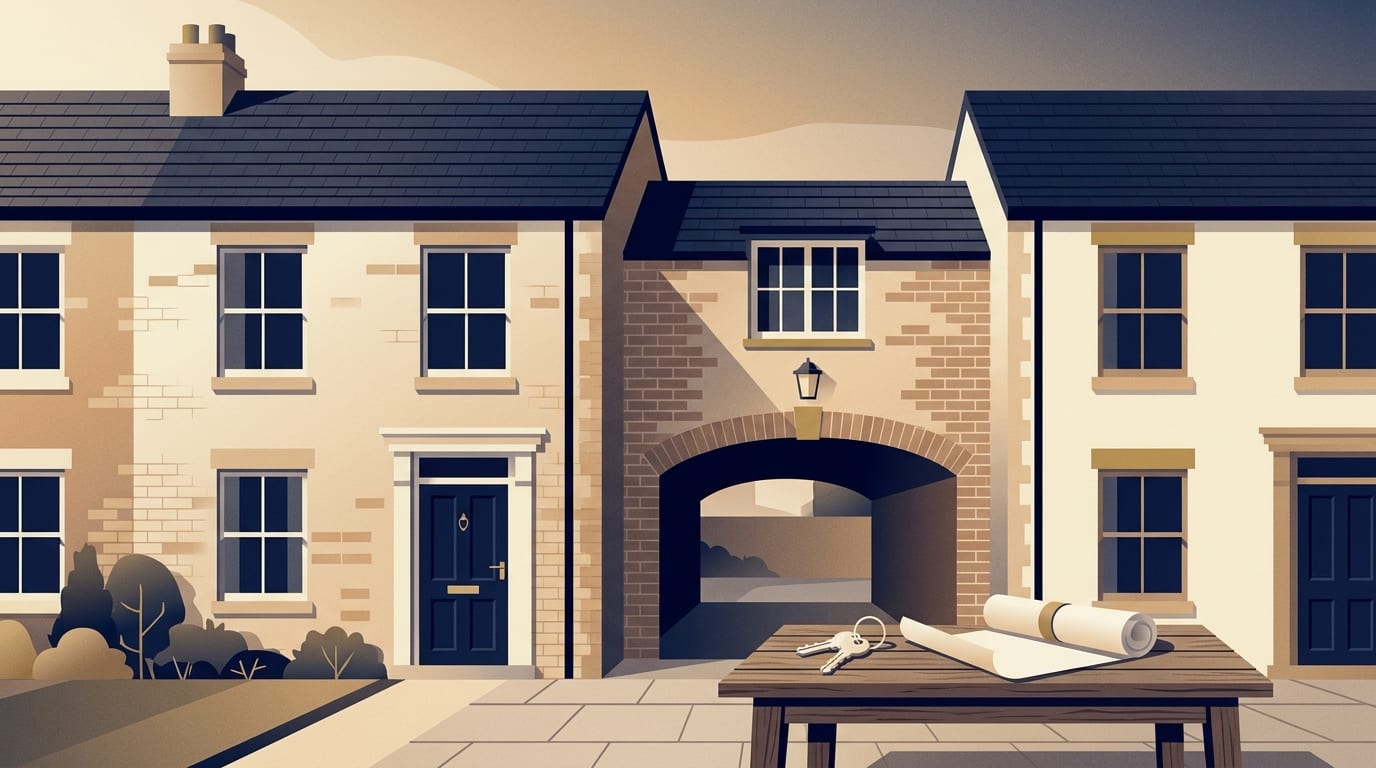
- A bedroom built over a shared archway.
- A first-floor room extending over a neighbour's sitting room.
- A balcony projecting over an adjoining property.
Why mortgage lenders look closely at them
Mortgage lenders look closely at flying freeholds because of how property law works in England and Wales. The general rule is that positive covenants do not automatically bind later owners.
A positive covenant is a legal obligation to do something. In property terms, this usually means an obligation to keep a shared roof or wall in repair. Because these obligations do not automatically pass to the new owner when a house is sold, a lender worries about how repairs will be managed in the future.
Lenders take different approaches to flying freeholds.
The table below shows the three main ways lenders approach flying freeholds.
|
Lender policy |
What it means for your mortgage |
|---|---|
|
Will not lend |
The lender declines the application on any property with this feature. |
|
Decide case by case |
The lender decides case by case. |
|
Lend under a set limit |
The lender may lend if the overhang is under a set limit, often 15 per cent of the building's total floor area according to RICS guidance for firms. |
Limits differ by lender, and you must ask your own lender what their exact rules are. Never assume a mortgage will be available until your own lender has confirmed it.
What lenders usually ask for
When a lender agrees to consider a property with a flying freehold, they want to see specific legal protections. They want confirmation of adequate rights of support and entry for repairs, and they may require a title indemnity policy.
Solicitors and licensed conveyancers have a duty to be aware of flying freeholds and advise accordingly during conveyancing. The title and plan are checked by the conveyancer to see what rights are written down.
Many lenders still lend where the flying element is small and the right rights are in place. Others may decline the application or impose conditions. If the deeds are old or silent on these rights, a solicitor may recommend a flying freehold indemnity policy.
What a surveyor or valuer does about it
Chartered surveyors carrying out home surveys or valuations need to be aware of flying freeholds and advise their clients accordingly. A flying freehold can be invisible on paper, especially if the property has been altered over the years. A physical survey may reveal what the legal documents do not.
When deciding which house survey to choose, remember that a survey may reveal what the documents do not, because a flying freehold can be invisible on paper.
The report describes the condition of the property, and what it covers depends on the survey level you choose.
A surveyor does not decide ownership or resolve legal boundaries. The title and plan are checked by the conveyancer. The surveyor's job is to report on the physical layout and condition, so your legal adviser knows exactly what to look for in the deeds.
What a survey costs and how long it takes
Surveys are sold at a fixed fee quoted up front. The price is driven by the survey level, property value, size, age, complexity and location. Matching the survey level to the age, type and condition of the property is vital.
The table below shows the typical costs and inspection times for the three RICS survey levels.
|
Survey level |
Typical inspection time |
Typical price range |
|---|---|---|
|
Level 1 |
1 to 2 hours |
£300 to £450 |
|
Level 2 |
2 to 4 hours |
£400 to £950 |
|
Level 3 |
4 to 8 hours |
£600 to £1,500 or more |
These are typical 2026 ranges, not quotes, and local prices will differ.
A Level 1 survey describes condition, flags risks and urgent defects, and suits conventional, newer homes in good condition. A Level 2 survey, still widely called a HomeBuyer Report, suits conventional homes in reasonable condition and adds advice on repairs and maintenance.
A Level 3 survey, still widely called a building survey or full structural survey, is the most detailed. It takes roughly four to eight hours and suits older, larger, altered, unusual or run-down homes. Reports usually follow within about 3 to 10 working days after the inspection. Always get two or three like-for-like quotes that state the level, whether a valuation is included and the turnaround time.
Rights of support and access for repairs
If your property overhangs a neighbour's land, you will eventually need access to maintain it. Ideally, your property deeds will include clear, written rights of access. If they do not, there is a legal fallback, but it is not a substitute for written rights in the deeds.
Under the Access to Neighbouring Land Act 1992 section 1, a person can apply to the court for an access order. This applies to someone who needs to enter a neighbour's land to carry out works reasonably necessary for the preservation of their own land, and who does not have consent.
Qualifying works include maintaining, repairing or renewing buildings. The court will not automatically grant this access. The court must not make the order if the entry would interfere with or disturb use of the neighbour's land, or cause hardship, to such a degree that the order would be unreasonable.
The court can refuse an order, so the Act is not a substitute for written rights in the deeds. Speak to a conveyancer about your own position.
Indemnity insurance and your conveyancer
If your conveyancer finds that the deeds are old or silent regarding rights of support and access, they may recommend a flying freehold indemnity policy. This is an insurance policy.
The policy protects the buyer and lender against certain financial losses. It is usually a relatively inexpensive one-off premium.
This premium is often paid by the seller.
An indemnity policy does not fix the physical problem or force a neighbour to grant you access. It is a financial protection, not a physical fix. Your conveyancer can advise on whether you need one.
Questions to ask before you offer
If an estate agent tells you a property has a flying freehold before you make an offer, gather the facts early. Asking the right questions can save you time and money on survey and legal fees later.
- Ask the estate agent what percentage of the floor area the flying freehold covers.
- Ask your mortgage broker or lender what their specific rules are for flying freeholds.
- Ask the seller if they already have an indemnity policy in place from when they bought the house.
- Ask the seller if there have ever been disputes with the neighbour over repairs or access.
- Ask your conveyancer to check the title plan as early as possible in the transaction.
Finding a qualified surveyor
When you instruct a professional to inspect a complex property, check their credentials. Look for a surveyor and a firm that are RICS regulated, and confirm both on the RICS Find a Surveyor service.
Under the Consumer Rights Act 2015, a surveyor's service must be carried out with reasonable care and skill. If you arrange the survey online or by phone, it normally carries a 14-day cooling-off period. However, if you ask for the work to start inside this period to meet a tight conveyancing deadline, you will pay for what has been done.
Common questions
What is a flying freehold?
A flying freehold exists when part of one freehold property sits above or below land or a building owned by someone else. It refers to freehold property built over land which does not form part of the property, such as a bedroom over a shared archway.
Does a flying freehold mean I cannot get a mortgage?
No, but it can restrict your options. Some lenders will not lend on any property with this feature, while others decide case by case. Some will lend if the overhang is under a set limit, often 15 per cent of the building's total floor area according to RICS guidance for firms. Limits differ by lender, so ask yours.
Will a surveyor spot a flying freehold?
Not always on its own. Chartered surveyors carrying out home surveys or valuations need to be aware of flying freeholds and advise their clients. Because a flying freehold can be invisible on paper, a physical survey may reveal what the legal documents miss.
Who pays for the flying freehold indemnity policy?
The policy is usually a relatively inexpensive one-off premium and is often paid by the seller. No premium figure is given here.
Who decides who owns the flying part?
Ownership comes from the title and plan, which the conveyancer checks. A surveyor does not decide ownership. If the position is unclear, ask your conveyancer or solicitor, who can give you legal advice.
Can I rely on the 1992 Act instead of written rights?
The Access to Neighbouring Land Act 1992 lets a person without consent apply to the court for an access order. The court must not make the order if the entry would be unreasonable because of interference, disturbance or hardship. It is not a substitute for written rights in the deeds.
Next steps to take
When you are buying a home with a flying freehold, you need to coordinate your surveyor, conveyancer and lender. Use this checklist to keep your purchase on track.
- Check your lender's criteria to ensure they accept flying freeholds before you apply for the mortgage.
- Book a survey once your offer is accepted and well before you exchange contracts.
- Instruct a chartered surveyor to inspect the property and report on its physical layout and condition.
- Tell your conveyancer about the flying freehold immediately so they can check the deeds for rights of support and access.
- Ask your conveyancer whether an indemnity policy is needed if the deeds are old or silent.
- Use the survey findings to get repair quotes if the shared structures are in poor condition, then decide whether to proceed or renegotiate.
A flying freehold does not have to stop you buying the house you want, provided you have the right professional advice. Once your offer is accepted, you can find a surveyor near you to inspect the property and highlight exactly how it interacts with the neighbouring building.
Find a top rated surveyor near you
1,519 surveyors across the UK, each ranked on their Google rating and the number of reviews behind it. Start with your county: