Buying a non-standard construction house means the property was built in a way that is not conventional brick or block walls with a tiled pitched roof. A mortgage lender may have its own rules on lending against these homes. Because of the unusual building materials the right choice is normally a Level 3 survey chosen with your surveyor's advice.
What non-standard construction means
Standard construction generally means cavity or solid walls made of brick or block beneath a roof made of slate or tile. If a property falls outside this definition it is classed as non-standard construction.
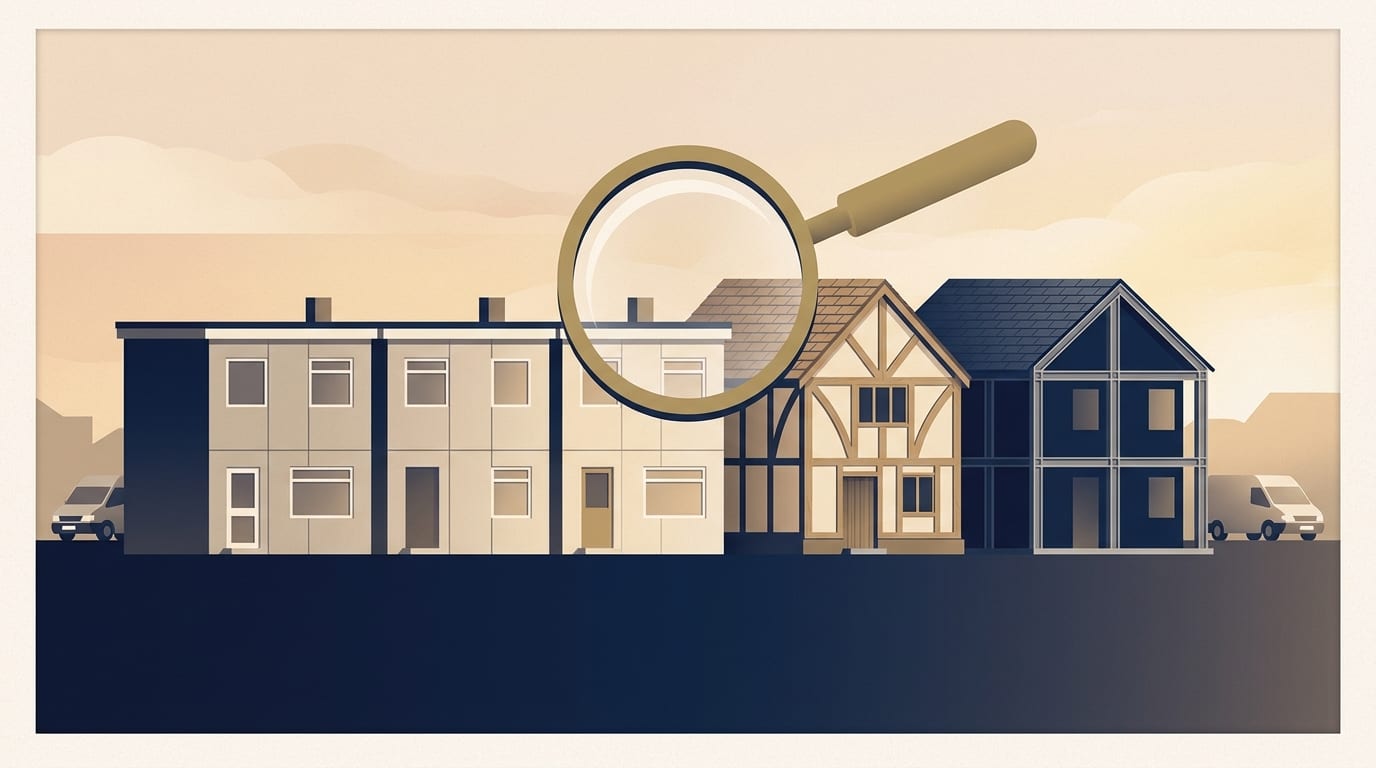
Examples include precast reinforced concrete houses, steel frame buildings, timber frame homes and prefabricated or system-built properties. It also covers homes with unusual roof coverings such as thatch. You might find out a property is non-standard from the estate agent, the property listing or your mortgage lender.
This label does not mean the house is unsafe or poorly built. It simply means the materials and building methods are different from the norm. The right survey level depends on the building, so ask a surveyor for advice.
Buying one of these homes requires a careful approach. You cannot rely on a standard mortgage valuation to tell you about the condition of the building. A mortgage valuation is not a survey and is simply a limited check carried out purely for the lender's benefit to confirm the property is worth the loan amount.
To understand what you are buying you need a detailed inspection by a qualified professional. A survey will not guarantee a home is completely free of defects. It will give you an expert assessment of the property condition so you can make a sound financial decision.
Why these homes can be harder to mortgage
Lenders may treat non-standard construction homes differently from conventional ones, and some may have their own rules about them.
Every lender has different rules on what they will and will not accept. Lender rules on these homes differ from lender to lender, so there is no single list of which construction types are affected.
Because lenders differ so much the best person to ask is a mortgage broker. You should always speak to a broker before paying for a house survey. A broker can check which lenders will consider the property.
Do not try to guess which lenders to approach based on internet forums. Speak to a professional who can look at the specific property details and match you with the right lender. Once you have a mortgage offer in principle you can move forward with arranging your survey.
Remember that the valuer acting for the mortgage lender is completely separate from the surveyor you hire to inspect the home. The valuer only cares about the lender's financial risk. Your surveyor works for you and cares about the physical condition of the building.
Which survey to choose
Home surveys follow three levels set by the Royal Institution of Chartered Surveyors. Level 1 describes basic condition and suits newer homes in good condition. Level 2 suits conventional homes in reasonable condition. Level 3 is the most detailed and is the right choice for an unusual or altered building.
An in-depth survey is recommended for properties unusual in their architecture or building material, such as a timber-framed or thatched-roof property. A building survey is the most detailed type and inspects areas including chimneys, attics, cellars and under floors. The official RICS consumer guide states that a Level 3 survey suits large, older or run-down properties, unusual or altered buildings and properties where major works are planned.
A Level 3 or an RPSA Building Survey is recommended for properties over 50 years old, of unusual design or in poor condition, or where you plan significant work. During these surveys the inspector is hands on, checking the attic and looking under floorboards. For a non-standard construction house this level of detail is essential.
Surveys are sold at a fixed fee quoted up front. The price depends on the survey level, property value, size, age, complexity and location. The table below shows the typical cost and time required for Level 2 and Level 3 surveys.
|
Survey level |
Typical price range |
Inspection time |
|---|---|---|
|
Level 2 |
£400 to £950 |
2 to 4 hours |
|
Level 3 |
£600 to £1,500 or more |
4 to 8 hours |
These are typical 2026 ranges rather than quotes, and local fees will differ based on the property.
After the inspection finishes the written report usually follows within about three to ten working days. Understanding what a level 3 survey covers will help you see why it is the best fit for an unusual property.
What a surveyor can tell you about the construction
A qualified surveyor will inspect the visible parts of the property to identify the construction method and assess its condition. They will look for signs of wear, damp, structural movement and decay in the unusual building materials. The report uses condition ratings shown as traffic lights to highlight urgent defects and risks.
There are strict rules on what a surveyor can and cannot do during the inspection. According to the RICS Level 3 description the surveyor does not force or open up the fabric of the building without owner consent. This means they will not cut into walls or otherwise open up the structure.
If the surveyor finds harmful or dangerous materials they must report them and ask for further instructions. They do not carry out an asbestos inspection. The report will flag the concern and ask for further instructions.
Do not attempt to diagnose construction types from photos on the property listing. You should also never carry out your own structural checks, enter lofts, lift drain covers or disturb materials that may contain asbestos. Leave the physical inspection entirely to the trained professional.
If the surveyor cannot see enough of the structure to confirm its condition they will recommend further investigation. The surveyor will explain what further investigation is needed and who should carry it out. You must take these recommendations seriously before you commit to buying the house.
Designated defective housing explained
Some homes are in buildings that have been designated as defective by law.
Under the Housing Act 1985 the Secretary of State may designate as a class buildings that contain one or more dwellings where the buildings are defective because of their design or construction. This happens when the defects have become generally known and the value of some or all of the dwellings has fallen substantially. A dwelling in a designated building is called a defective dwelling.
Part XVI of the Act is headed Assistance for owners of defective housing. A person is eligible for assistance only if they hold a qualifying interest in a dwelling designated as defective and meet the specific conditions laid out in the Act. The Act sets out the conditions, so a conveyancer or solicitor can tell you whether any apply.
Ask your mortgage broker what a designation would mean for lending on the home.
You must ask your conveyancer whether a designation applies to the home you want to buy. They can check the legal status of the building. Do not assume a home is unaffected without that check.
Questions to ask before you pay for a survey
Choosing the right surveyor is just as important as choosing the right survey level. You need someone with local knowledge and experience of unusual building types. Always get two or three like-for-like quotes that state the level, whether a valuation is included and the turnaround time.
Before you instruct a firm you should ask them a few direct questions to ensure they are the right fit. This helps you avoid paying for a report that does not give you the answers you need.
- Ask if the surveyor has specific experience inspecting the exact construction type of the property.
- Ask if the firm is RICS Regulated and whether the surveyor holds AssocRICS, MRICS or FRICS status.
- Ask if the quoted price includes a valuation or just the condition report.
- Ask how soon the surveyor can visit the property and how many days it will take to receive the written report.
- Ask if the surveyor will talk the report through by phone once you have read it.
- Ask to see their terms of engagement so you understand exactly what is included and excluded.
Under the Consumer Rights Act 2015 a service must be carried out with reasonable care and skill. RICS regulated firms must have a complaints handling procedure, give consumers free access to an independent alternative dispute resolution provider, and hold professional indemnity insurance. You can confirm a surveyor's credentials on the RICS Find a Surveyor service.
Services arranged online or by phone normally carry a 14-day cooling-off period. If you ask for the work to start inside this period you will pay for what has been done up to the point you cancel.
Working with your broker and conveyancer
Buying a non-standard property requires your broker, your conveyancer and your surveyor to work together. Your broker handles the lender side of the purchase. They need to know the exact construction type as soon as the surveyor identifies it so they can confirm the lender is still willing to proceed.
Your conveyancer handles the legal side of the purchase. They will check the title deeds, run local authority searches and ask the seller formal questions about the property. They do not visit the house and they cannot give you advice on its physical condition.
You must share your survey report with your conveyancer. The report may mention matters with a legal side, and your conveyancer can follow those up.
Your conveyancer will use the survey findings to ask the seller's solicitor for more information. If a designation applies to the home, your conveyancer can advise on what it means. Never sign contracts or exchange until your conveyancer is satisfied with the legal documents.
Keep communication open between all parties. Book your survey as soon as your offer is accepted and well before exchange. Booking too late and delaying exchange is a common mistake that frustrates sellers and puts the deal at risk.
If the survey finds a problem
A Level 3 survey on an unusual or older home may well flag defects. The report will highlight these issues using condition ratings and explain what the problems mean for the building. Do not panic when you see a long list of repairs.
Your first step is to read the report carefully and speak to the surveyor on the phone. They can help you understand which issues are urgent and which are just normal maintenance for that type of building. If the surveyor recommends further investigation by a specialist you should arrange this immediately.
Once you understand the defects you need to find out what they will cost to fix. Contact local tradespeople who have experience with non-standard construction and ask them to visit the property. You must get written repair quotes so you have accurate figures to work with.
With written quotes in hand you have three options. You can proceed with the purchase at the agreed price and pay for the repairs yourself. You can try to renegotiate the house price by asking the seller to drop the price by the cost of the work. Or you can walk away from the deal completely.
Trying to renegotiate without written repair quotes is a common mistake. Sellers are much more likely to agree to a reduction if you can prove exactly what the repairs will cost. Keep your conveyancer involved in any price discussions so they can update the legal paperwork if the price changes.
Party wall rules for non-standard homes
If you plan to alter your non-standard home after you buy it you must understand the rules regarding shared boundaries. The Party Wall etc. Act 1996 applies in England and Wales only. It provides a framework for preventing and resolving disputes in relation to party walls, boundary walls and excavations near neighbouring buildings.
A building owner must give written notice before building on or at the boundary, working on an existing party wall or structure, or excavating near a neighbour's foundations. Notice is at least two months ahead for party structure works and one month for new boundary walls and excavations.
Your neighbour has 14 days to respond to the notice and silence counts as a dispute. In a dispute the owners appoint one agreed surveyor or one each, who produce a party wall award. You cannot act as your own surveyor for this process.
The building owner usually pays all surveyors' fees where the work is solely for their benefit. An award can be appealed in the county court within 14 days. Starting party wall work without serving notice is a serious mistake which can lead to an injunction stopping your project.
Common questions
Can you get a mortgage on a prefabricated house?
Whether a lender will lend on a prefabricated house depends on the lender and the specific construction type. You should speak to a mortgage broker to find a lender who accepts the exact type of property you want to buy.
Are timber frame houses hard to sell?
RICS says a survey is particularly useful for a property with a timber frame. Lender rules differ, so ask a mortgage broker about the specific home before you pay for a survey.
Do I need a structural engineer instead of a surveyor?
You should start with a Level 3 building survey carried out by a residential surveyor. The surveyor will inspect the whole property and assess its overall condition. If they spot a specific structural failure that requires complex calculations they will advise you to hire a structural engineer for that single issue.
Does standard home insurance cover non-standard construction?
Tell insurers about the construction type and ask about cover before you exchange contracts, since the building type may affect what is offered.
Next steps for your purchase
Buying a non-standard construction house requires clear advice and careful timing. Follow these steps to protect your money and keep the purchase moving forward.
- Speak to a mortgage broker to confirm you can get a loan on the specific building type.
- Ask your conveyancer if the property is classed as designated defective housing.
- Get two or three quotes for a Level 3 survey and check the surveyors are RICS regulated.
- Book the survey as soon as your offer is accepted and well before exchange.
- Read the report, speak to the surveyor and get written quotes for any necessary repairs.
Once you understand the risks and have checked lending with a broker you can begin the process to find a surveyor near you.
Find a top rated surveyor near you
1,519 surveyors across the UK, each ranked on their Google rating and the number of reviews behind it. Start with your county: