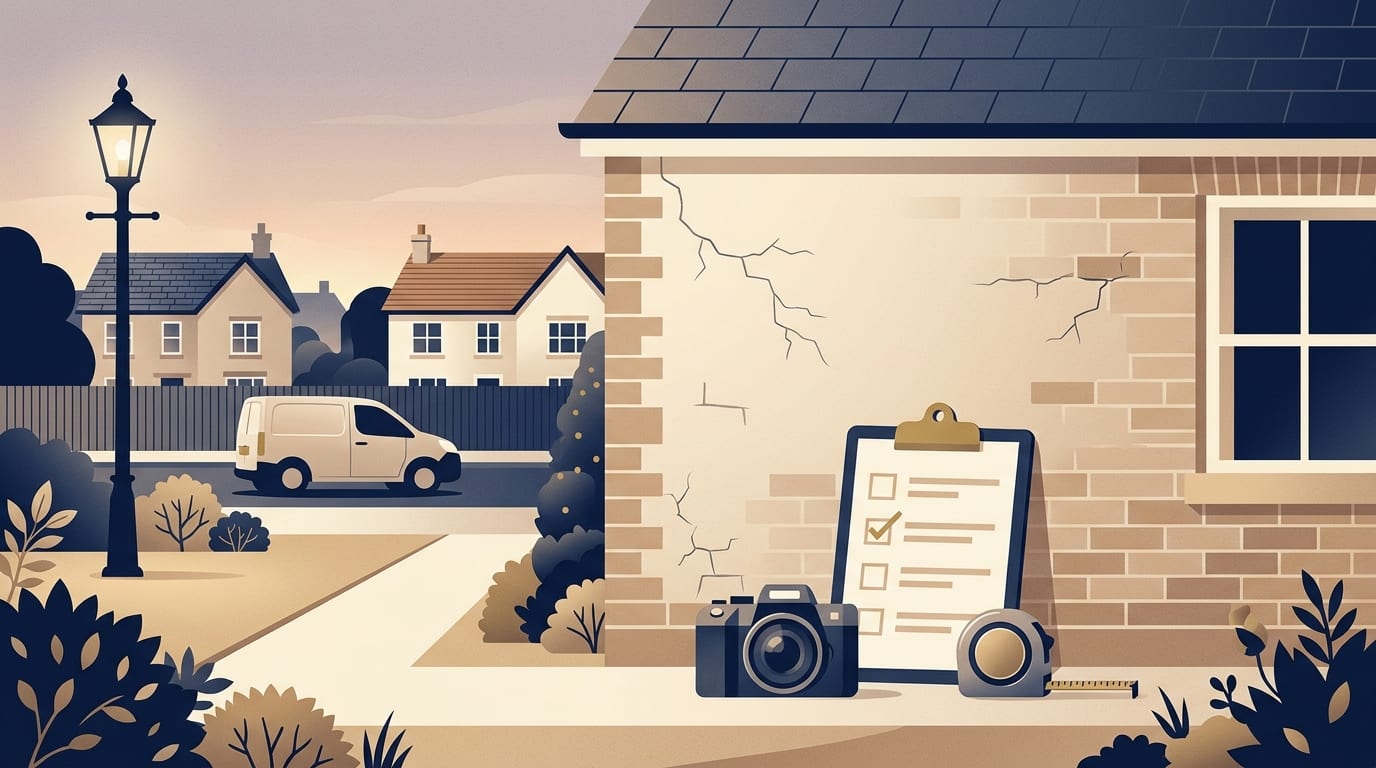
A schedule of condition is a factual written and photographic record of the condition of your property before your neighbour starts building work. The typical cost in 2026 is between £200 and £600, which the person carrying out the building work usually pays. Having this document means that if cracks or other damage appear during the project, you have a record that helps show what your home looked like before the work started.
What a schedule of condition is
When a neighbour plans a major construction project, such as building an extension, converting a loft or excavating a basement, their work may affect your property. A schedule of condition is a factual record of the condition of a property at a specific point in time before any of this activity starts. It is usually prepared for legal or contractual reasons, giving both you and the building owner an agreed baseline.
The document is a detailed written schedule setting out the location and nature of each item inspected. A surveyor inspects the relevant parts of your property and records the location and nature of each item inspected and its condition.
This record is strictly factual and observational. Its job is to capture the physical state of the building before the work starts. This differs entirely from a home survey, which is designed to advise a buyer on a property's overall condition and repair needs.
Why it matters if your neighbour builds
A dated record of your home protects you if next door's works cause cracks or structural damage. Without a formal record, it can be hard to agree what was there before. The builder might claim a crack was already there, while you know it appeared after they started knocking down a wall.
The government strongly advises having a schedule drawn up before the work begins. If you do not have this document, damage may otherwise be hard to attribute to the construction work. A record made before the work gives a baseline to compare against, though it does not settle who is responsible.
Taking your own photographs is not a substitute for a professional schedule. Snapping pictures on a mobile phone lacks the independent authority, consistent lighting and precise written descriptions a surveyor provides. A schedule is only worth having when prepared by a surveyor who can return and compare it later if a problem occurs. Relying on your own memory or informal photos leaves you vulnerable to a prolonged disagreement.
What a schedule of condition contains
A thorough schedule of condition follows a clear, logical structure so that anyone reading it months later can understand exactly what the surveyor saw. It combines precise written descriptions with visual evidence. A schedule can contain the following.
- The primary purpose of the report and the legal context for the inspection.
- The property location and the exact extent of the areas being inspected.
- A construction description explaining how your home is built and the materials used.
- The inspection date, time and weather.
- Clear drawings mapping out the layout of the rooms bordering the work.
- Definitions of severity terms.
- Photographs or video.
This strictly factual record ensures that all parties understand exactly what the baseline condition is. By defining terms clearly at the start, the schedule leaves no room for confusion or debate if the surveyor needs to re-inspect the property to assess new damage later.
Who prepares the schedule
You cannot act as your own surveyor to prepare this document. A schedule is only worth having when prepared by a surveyor who can compare it later. When you are looking for someone to carry out the inspection, look for the letters AssocRICS, MRICS or FRICS after the surveyor's name.
These letters demonstrate that the surveyor is a qualified member of the Royal Institution of Chartered Surveyors. You should also look for the words RICS Regulated for the surveying firm. You can confirm both the individual surveyor and the firm on the RICS Find a Surveyor service. The Residential Property Surveyors Association is another recognised body for residential surveyors, offering its own survey products.
Choosing a regulated firm offers you specific consumer protections. RICS regulated firms must have a formal complaints handling procedure in place. They must give consumers free access to an independent alternative dispute resolution provider if a problem cannot be solved internally. They are also required to hold professional indemnity insurance to cover their work.
Under the Consumer Rights Act 2015, any service you pay for must be carried out with reasonable care and skill. If you arrange the surveyor's services online or by phone, these contracts normally carry a 14-day cooling-off period. However, if you ask for the inspection to start inside that cooling-off period, you must pay for what has been done up to that point.
How it fits into a party wall award
The Party Wall etc. Act 1996 is the primary legislation dealing with boundary construction, and it applies in England and Wales only. It provides a strict legal framework for preventing and resolving disputes in relation to party walls, boundary structures and excavations near neighbouring buildings. A building owner must give written notice before building on or at the boundary, working on an existing party wall or structure, or excavating near a neighbour's foundations.
The timelines for this notice are strict. Notice must be given at least two months ahead for party structure works, and one month ahead for new boundary walls and excavations. A neighbour who receives a notice should reply in writing within 14 days. If they do not respond within 14 days to a party structure or excavation notice, a dispute is deemed to have arisen.
In a dispute, the owners must appoint surveyors to resolve the matter. You can both agree to use one agreed surveyor, or you can choose to appoint one each. These surveyors will then produce a legal document called a party wall award. A schedule of condition is not a requirement of the Act, but the explanatory booklet strongly advises one.
The government explanatory booklet on the Party Wall Act states that the award sets out the work, when and how it is carried out, and any additional protective work required. It often includes a schedule of condition and sets out access rights for inspection. Starting party wall work without serving notice is a common mistake, and the adjoining owner may seek a court injunction.
The RICS consumer guide on party walls confirms that the award usually records the condition of the relevant part of the adjoining property before work begins. It may also grant access so surveyors can inspect the work in progress. Understanding what happens when a neighbour dissents to a party wall notice will help you navigate the process smoothly.
What a schedule of condition costs in 2026
The cost varies with the size of the property and the extent of the inspection.
The typical cost for a schedule of condition in 2026 is £200 to £600. However, the building owner carrying out the works usually pays all reasonable surveyors' fees, including the fees for your appointed surveyor, where the work is solely for their benefit. This means you usually do not have to pay for it yourself when your neighbour is the one building.
To show how this compares to the reports buyers commission when purchasing a home, the table below outlines the different levels of property inspection. A home buyer's survey is a different service entirely, assessing the whole property for a purchaser rather than recording a factual baseline for a neighbour. A mortgage valuation is not a survey at all, but rather a limited check for the lender's benefit.
The following table outlines the different types of property inspections and their typical costs.
|
Inspection type |
Typical 2026 cost |
Main purpose |
|---|---|---|
|
Schedule of condition |
£200 to £600 |
Records condition before neighbour builds |
|
Level 1 survey |
£300 to £450 |
Describes condition and flags urgent defects |
|
Level 2 survey |
£400 to £950 |
Suits conventional homes in reasonable condition |
|
Level 3 survey |
£600 to £1,500 or more |
Suits older, larger, altered or run-down homes |
These are typical 2026 ranges rather than quotes, and local fees will differ.
What happens if damage appears
If you notice new cracks, falling plaster, jammed doors or other damage while your neighbour's builders are working, you must act calmly and formally. Tell your neighbour and the appointed party wall surveyors in writing immediately. Explain exactly what you have found and where it is located.
Ask the surveyor to compare the new damage against the schedule of condition. The surveyor can use the record, with its photographs, drawings and definitions of severity terms, to check what has changed.
The party wall surveyors can re-inspect the property to check for damage and agree on the needed repairs. You must allow access for this to happen. The Act states that the adjoining owner must, when necessary, allow in the building owner's workmen and surveyors for Act-related works. The Act provides for 14 days' notice, except in emergencies.
Do not try to diagnose the defects yourself. Never carry out your own structural checks, climb into lofts, lift drain covers, or disturb materials that may contain asbestos. Do not monitor cracks with your own gauges or assume you know who is legally liable. For legal questions about boundaries or disputes, speak to a conveyancer or solicitor. Leave the inspection and the comparison strictly to the appointed surveyors.
Checklist before the work starts
Before any heavy machinery arrives or scaffolding goes up next door, you need to ensure your home is fully protected. Follow this checklist to keep the process on track.
- Wait for your neighbour to serve written notice at least one or two months before the work begins.
- Respond to the notice in writing within 14 days, because silence counts as a dispute for a party structure or excavation notice.
- Read about how to serve a party wall notice so you understand exactly what paperwork your neighbour should provide.
- Appoint an agreed surveyor or your own independent surveyor to handle the party wall award.
- Check that the surveyor is RICS regulated and has experience with your specific property type and the local area.
- Ask the surveyor whether the party wall award will include a schedule of condition, since awards often do.
- Allow the surveyor access to your home to take photographs and write the schedule before the builders start.
- Keep a copy of the final party wall award and the schedule of condition in a safe place until the construction is completely finished.
Common questions
Can I use my own photographs instead of a schedule?
Your own photographs are not a substitute for a professional schedule of condition. A schedule is only worth having when prepared by a surveyor who can compare it later. Without a formal, independent record that includes clear definitions of severity terms, damage may be hard to attribute to the building work.
Who pays for the surveyor?
The building owner carrying out the work usually pays all surveyors' fees where the work is solely for their benefit. This includes the fees for your appointed surveyor.
Is a schedule of condition a legal requirement?
It is not a strict requirement of the Party Wall etc. Act 1996, but the government strongly advises having one. The party wall award usually records the condition of the relevant part of the adjoining property before work begins.
What happens if I disagree with the party wall award?
Once the surveyors produce a party wall award, it is a legally binding document that governs how the work proceeds. However, an award can be appealed in the county court if you disagree with it. You must make this appeal within 14 days of the award being served to you.
Will a schedule of condition guarantee compensation?
A schedule of condition provides factual evidence of what your property looked like before work started, but it does not guarantee compensation. It lets party wall surveyors re-inspect and check for damage and needed repairs.
What to do next
When your neighbour tells you they are planning an extension, loft conversion or basement excavation, taking the right steps early will protect your property. A verbal agreement over the garden fence is not enough to secure your home against structural risks.
- Wait for the formal written notice from your neighbour and respond within 14 days to protect your rights under the Act.
- Decide whether to use an agreed surveyor or appoint your own independent party wall surveyor to represent your interests.
- Check the RICS Find a Surveyor service to ensure the professional you choose is fully qualified and regulated.
- Confirm that the surveyor will prepare a detailed schedule of condition before any building work begins on the boundary.
- Ensure the surveyor has full access to the relevant parts of your home to take photographs, make drawings and record the baseline condition.
Taking these steps helps you have an independent, factual record ready if anything goes wrong during the build. You can use the directory to find a surveyor near you who understands the party wall process and can prepare a thorough schedule for your home.
Find a top rated surveyor near you
1,519 surveyors across the UK, each ranked on their Google rating and the number of reviews behind it. Start with your county: