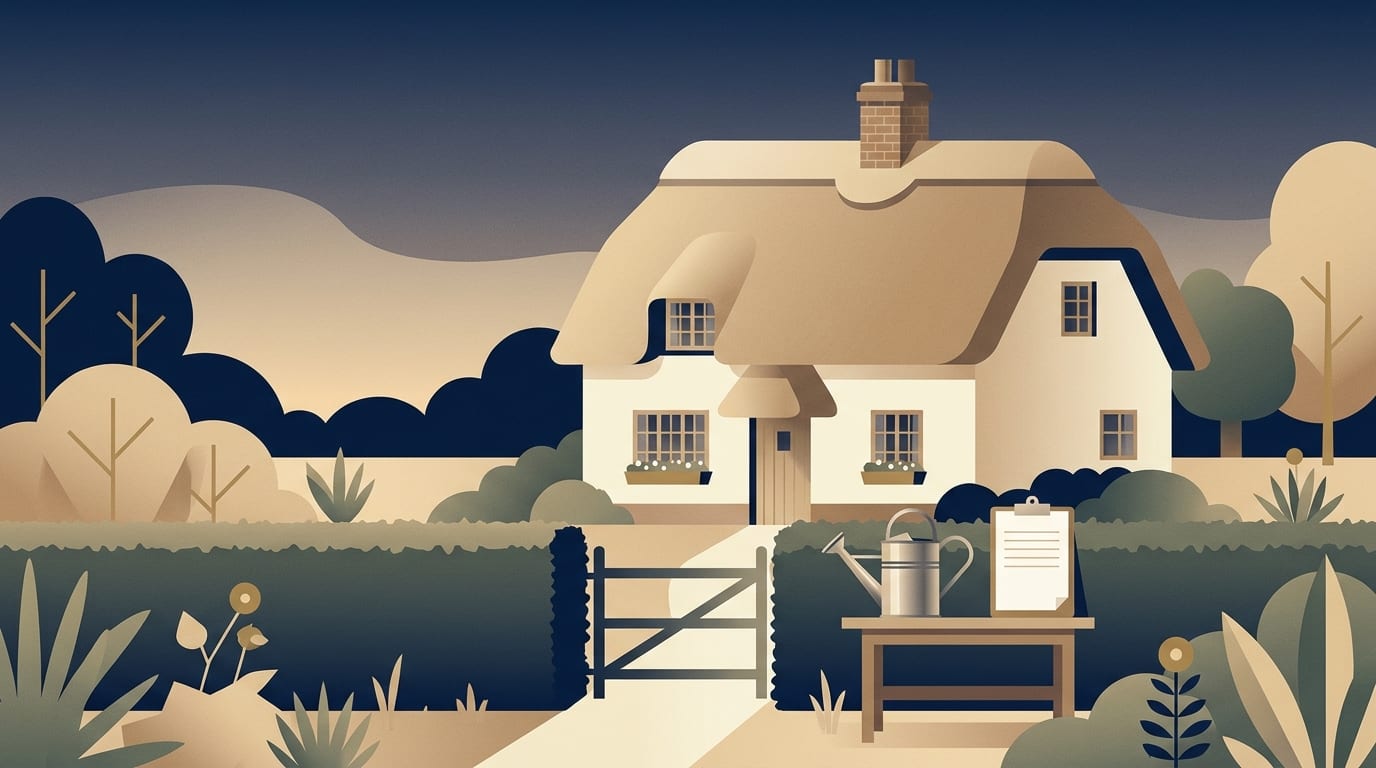
A thatched roof is exactly the sort of unusual feature where a survey is particularly useful. Because a thatched cottage is usually an older building, a Level 3 survey is the usual choice, though you should pick the level with your surveyor's advice. The surveyor looks at the property as a whole, while a specialist master thatcher can be asked to inspect the thatch itself.
Why a thatched cottage needs more than a basic survey
When you buy with a mortgage, the lender carries out a mortgage valuation. This is a limited check for the lender's benefit to confirm the property provides suitable security for the loan. A mortgage valuation is not a survey. Relying on the mortgage valuation to tell you about the condition of an old cottage is a common mistake.
To understand what you are buying, you need a home survey. Surveys are sold at a fixed fee quoted up front. The price is driven by the survey level, the property value, size, age, complexity and location.
A Level 1 survey describes the general condition of the home and flags risks and urgent defects. This level suits conventional, newer homes in good condition. Thatched cottages are rarely new and rarely built using standard modern methods. Many are older or unusual buildings of the kind where RICS says a survey is particularly useful.
Choosing the cheapest survey level for an old or altered house means you will not get the depth of advice you need to maintain it. A basic report gives less detail than a Level 3 survey, which is the most detailed option.
Which RICS survey level to choose
Home surveys follow three levels set by the Royal Institution of Chartered Surveyors. The official guidance states a survey is particularly useful if the property is particularly old or unusual, has a timber frame or thatched roof, or is a listed building.
A Level 2 survey, still widely called a HomeBuyer Report, suits conventional homes in reasonable condition. It adds advice on repairs and maintenance, and comes as a survey only or a survey and valuation. The visual, non-intrusive inspection takes two to four hours.
A Level 3 survey, still widely called a building survey or full structural survey, is the most detailed option. It suits older, larger, altered, unusual or run-down homes, or homes you plan to alter. The inspection takes four to eight hours. You can read more to understand what a level 3 survey covers before you book.
The table below shows the typical cost and inspection time for the three survey levels.
|
Survey level |
Typical price range |
Inspection time |
|---|---|---|
|
Level 1 |
£300 to £450 |
1 to 2 hours |
|
Level 2 |
£400 to £950 |
2 to 4 hours |
|
Level 3 |
£600 to £1,500 or more |
4 to 8 hours |
These are typical 2026 ranges rather than quotes, and local fees will differ.
Reports use condition ratings shown as traffic lights to highlight the urgency of repairs. When you hire a professional, look for AssocRICS, MRICS or FRICS after the surveyor's name and the words RICS Regulated for the firm. Confirm both on the RICS Find a Surveyor service. The RPSA is another recognised body for residential surveyors with its own survey products.
RICS regulated firms must have a complaints handling procedure, give consumers free access to an independent alternative dispute resolution provider, and hold professional indemnity insurance. Under the Consumer Rights Act 2015, a service must be carried out with reasonable care and skill. Services arranged online or by phone normally carry a 14-day cooling-off period. If you ask for the work to start inside this period, you pay for what has been done.
What the surveyor can and cannot say about the thatch
A building surveyor assesses the overall structural condition of the cottage. They look for signs of damp, timber decay, leaks and structural movement as part of a visual, non-intrusive inspection.
Surveyors conduct a visual, non-intrusive inspection. Not reading the terms of engagement is a common mistake, leading buyers to be surprised when the surveyor does not lift carpets, move furniture or test services. Do not try to carry out your own structural checks. Never enter lofts, lift drain covers, or disturb materials that may contain asbestos. Do not attempt to inspect the roof or check chimneys yourself.
The surveyor will not certify the thatch. They are not master thatchers. They will not tell you exactly how many years the thatch has left.
If the surveyor notes potential issues with the roof covering, they will recommend further investigation. Ignoring recommendations for further investigation leaves you at risk of unexpected bills. To get a detailed report on the condition of the materials, you should instruct a specialist master thatcher to carry out a separate inspection of the thatch.
How long thatch lasts
The lifespan of a thatched roof depends heavily on the material used and its quality. The pitch of the roof also matters. The skill of the thatcher who laid it is another major factor in determining its longevity.
Location plays a significant role. High humidity shortens the life of the roof, as do pollutants and nearby trees. Damage by vermin, bird damage, and damage by tradespeople unfamiliar with thatch will also reduce how long it lasts. The roof's breathability is essential to stop moisture building up inside the materials.
Typical lifespans vary by material, and the figures below are a guide rather than a promise:
- Water reed lasts 25 to 40 or more years
- Combed wheat reed lasts 25 to 35 years
- Longstraw lasts 15 to 30 years
- Ridges last 10 to 15 years
The ridge typically has a shorter life than the main coat, so it is usually renewed more often.
Questions to ask the seller
Before you buy a thatched property, you need specific details about its history and maintenance. Ask these questions to the seller through your conveyancer.
- Is the property listed and what is its grade?
- What fire precautions are in place, such as fire barriers, fire-retardant spray, chimney linings and alarms?
- When was the roof last inspected, repaired or re-thatched, and by whom?
- What thatch material is used for the coat and the ridge?
- When was the chimney last checked and swept?
- Are there any open fires or wood burners?
- Have there been nearby trees, bird or vermin problems in the last five years?
- When were the electrics last checked?
These details help you understand the maintenance schedule you are taking on. Fire precautions, chimneys and wood burners are also the areas specialist insurers ask about.
If the seller cannot provide paperwork for electrical checks or chimney sweeping, ask your conveyancer how to get these checked by qualified people before you exchange contracts.
Insurance for a thatched home
It is very important to have buildings insurance on a thatched property, with appropriate cover and the correct rebuild cost. The rebuild cost is the price of rebuilding the house from scratch if it is destroyed, which is different from the market value.
If you are 50% underinsured you may receive only about 25% of the sum you expected when you make a claim. This is why the rebuild cost matters.
Insurance for thatched properties is generally not more than for conventional roofed houses if you use specialist thatch insurers. However, specialist insurers now ask for more checks and precautions. They will ask about thatched roof inspections, electrical inspections, fire sprays and barriers, water source availability, listing status, chimneys, woodburners and alarms.
Insurers often survey the property within the first few weeks of a policy to verify these details. Ask what the insurer expects so that you can meet those requirements.
Cheaper cover may be cheaper for a reason, so compare policies like for like. Always ask insurers about cover and their specific requirements well before you exchange contracts.
What re-thatching costs and why quotes vary
Re-thatching is a major expense. It is usually priced by roof area in squares. One square is 10 feet by 10 feet, which equals 100 square feet. The average roof is about 6 to 12 squares, though some are 4 and some are 80.
The cost depends on the roof shape, the ridge type, wiring, flashing, new battens and the coat thickness. A more complex roof shape can add to the cost.
Roof structure problems may only show once the old thatch is removed. Any repairs the structure needs will add to the final bill, which is why the quote should say what is and is not included.
Get written quotes from more than one thatcher and check each covers the same work. A complete quote should include:
- The cost of scaffolding
- All materials for the coat and ridge
- The agreed thatch thickness
- Clearing up and removing the old thatch
- Insurance
Trying to renegotiate without repair quotes is a common mistake. If your survey shows the roof needs replacing soon, present these detailed written quotes to the seller to explain your revised offer.
Listed thatched homes
Some thatched cottages are listed. Reports and surveys are useful when the property is listed, and listed status may limit what you can change.
A listed thatched home may need listed building consent for some work, so check with the council before changing anything.
You can learn more about listed homes in the guide on why older homes need a specialist.
Planning extensions and the Party Wall Act
If you are buying a thatched cottage and planning an extension, loft conversion or basement, you must understand your legal duties to your neighbours. The Party Wall etc. Act 1996 applies in England and Wales only.
A building owner must give written notice before building on or at the boundary, working on an existing party wall or structure, or excavating near a neighbour's foundations. Notice is at least two months ahead for party structure works and one month for new boundary walls and excavations.
The neighbour has 14 days to respond, and silence counts as a dispute. Starting party wall work without serving notice is a serious error and can lead to an injunction stopping your project.
In a dispute the owners appoint one agreed surveyor or one each, who produce a party wall award to govern how and when the work happens. You cannot act as your own surveyor. The building owner usually pays all surveyors' fees where the work is solely for their benefit. An award can be appealed in the county court within 14 days.
Common questions
Do you need a valuation with your survey?
A Level 2 survey comes as a survey only or a survey and valuation. Whether a Level 3 survey includes a valuation depends on the quote, so ask the surveyor. Comparing quotes that are for different levels or exclude a valuation is a common mistake, so always check what the fixed fee includes.
Who arranges the survey?
The buyer is responsible for choosing the surveyor, booking the inspection and paying the fee. You should get two or three like-for-like quotes that state the level, whether a valuation is included and the turnaround time. Book the survey once your offer is accepted and well before the exchange of contracts. Booking too late and delaying exchange is a stressful mistake.
Will the surveyor check the boundaries?
A surveyor will not give legal advice on contracts, boundaries or disputes. If you are unsure where the legal boundary lies, ask a conveyancer or solicitor.
What happens if the cottage has structural defects?
If the Level 3 survey identifies structural movement, damp or timber decay, the surveyor will explain how serious it is. Use these findings to get repair quotes from specialist tradespeople. You can then decide whether to proceed, renegotiate the price, or walk away, with your conveyancer involved in the process.
Next steps before you exchange
Buying a thatched cottage requires careful preparation. Match the survey level to the age, type and condition of the property. Follow these steps to protect your investment:
- Ask your chosen surveyor whether a Level 3 survey is the right fit for the cottage.
- Get two or three like-for-like quotes and ask about the surveyor's experience with thatched properties in the local area.
- Ask whether the surveyor will talk the report through by phone once it is ready.
- Instruct your conveyancer to ask the seller the essential questions about fire precautions, chimney linings and the last re-thatch.
- Speak to a specialist thatch insurer to confirm you can get adequate cover and find out what safety checks they require.
Gathering the right information early stops you facing unexpected bills after you move in. To start comparing local options and get the process moving, find a surveyor near you today.
Find a top rated surveyor near you
1,519 surveyors across the UK, each ranked on their Google rating and the number of reviews behind it. Start with your county: