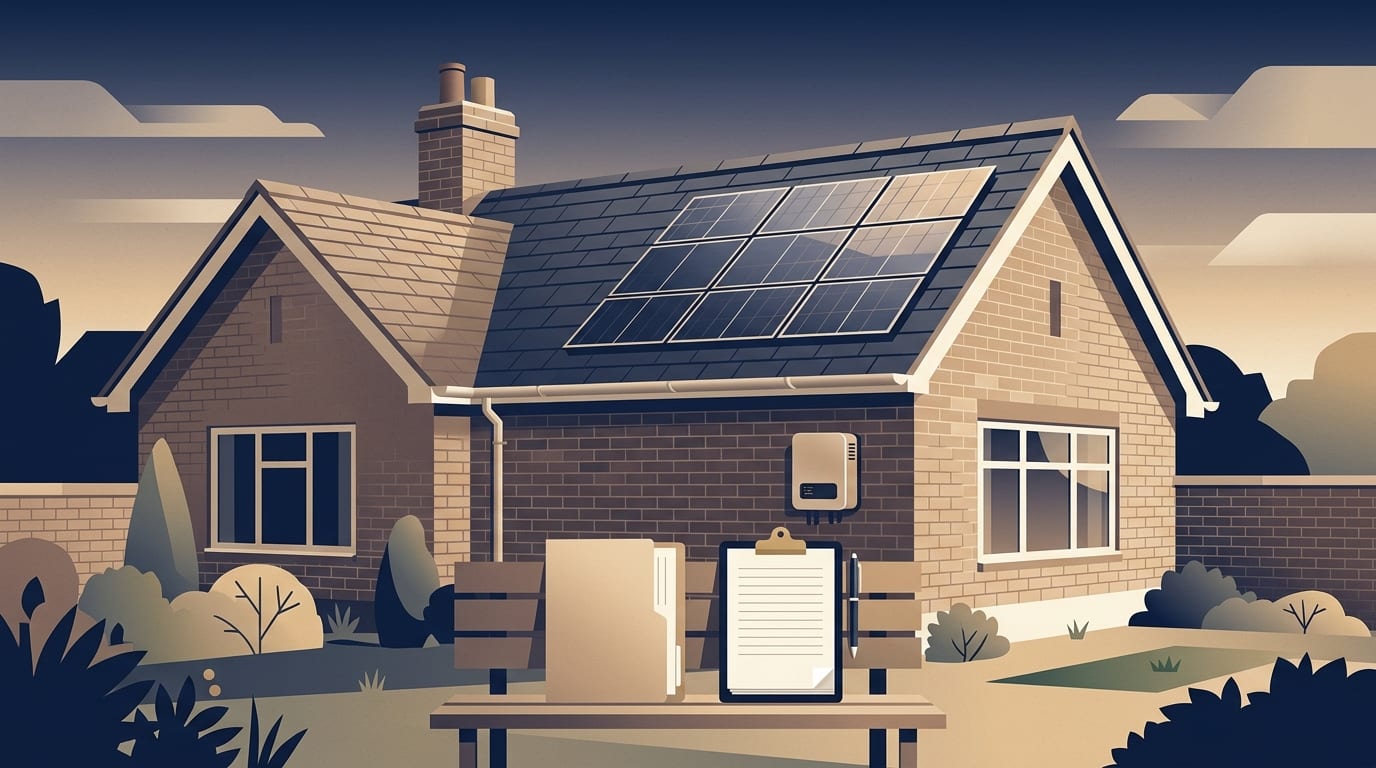
When you buy a house with solar panels on the roof, a RICS Level 2 or Level 3 survey gives you a visual inspection of the property. The surveyor cannot test the panels or the electrics during this visit. The key risks are legal and paperwork questions for your conveyancer, such as who owns the panels, what any lease says and what your mortgage lender will accept.
A home survey looks at the physical condition of the house and the roof, and it treats the panels themselves differently from the traditional bricks and mortar.
Because panels generate electricity, they are classed as part of the energy systems of the house. The RICS Level 2 description says the surveyor does not carry out specialist tests. This means a standard home survey will not tell you if the system is working efficiently or safely.
The other major change is legal ownership and the paperwork attached to the property. Many solar panels are not owned by the person selling the house. If a company installed them, it may hold a lease over the roof space. This can introduce a third party commercial company into your house purchase.
What your surveyor will and will not check
A home survey is a visual inspection designed to report on the condition of the building. The surveyor reports on what can be seen, and the panels themselves are not tested.
The RICS Level 2 description states that the visual inspection cannot assess the efficiency or safety of electrical, gas or other energy sources. Services are generally hidden, only the visible parts can be inspected and the surveyor does not carry out specialist tests. They will not carry out specialist tests of the system.
The surveyor will inspect the roof structure from the inside if they can access the loft. The rules state that if safe and reasonable, the surveyor enters the roof space and visually inspects the roof structure, but does not move or lift insulation material, stored goods or other contents.
Your surveyor will also not read or advise on the lease or the installation guarantees. The RICS description confirms the surveyor does not act as a legal adviser and does not comment on any legal documents. Where they spot issues for your legal advisers they may refer to them in the report, leaving the detailed checks to your conveyancer. You can read more about what a level 2 home survey covers to understand these limits.
Owned panels and leased panels
When you view a house with solar panels, you need to find out immediately whether the seller owns them outright or whether they are leased. This distinction affects your purchase, so ask your conveyancer to get written proof.
If the seller bought the panels and paid for the installation, they own the equipment outright. Ask your conveyancer to confirm in writing what is included in the sale.
Leased panels work differently. According to the Ofgem facts on third party ownership, the owner of an installation may be different from the owner of the property. Most third party ownerships operate under the rent-a-roof model.
The third party installs the panels, the homeowner receives the electricity generated to lower their bills, and the third party owner receives the financial generation and export payments. Under this model, the company owns the panels and holds a long lease on your roof space.
Who owns the panels and the payments
The financial returns from older solar panels come through a government scheme called the Feed-in Tariff. This scheme paid the owner of the panels for the electricity they generated and exported to the grid.
If the panels are leased, the rent-a-roof company receives the FIT generation and export payments rather than the homeowner. Where an installation is owned by a rent-a-roof company, Ofgem expects a signed agreement, such as a lease, to be in place. Ask your conveyancer to see it.
Finding out who currently owns the panels can sometimes be difficult for the seller. Installations are sometimes sold between companies, especially when companies go out of business. This change in ownership may not be communicated to the homeowner, meaning the seller might think they are dealing with the original installer when the lease actually belongs to an entirely different corporation.
If there is confusion over who owns the panels, a homeowner can request details through a Subject Access Request to the FIT Register team. If the seller cannot provide up to date ownership paperwork, ask your conveyancer how to get it.
What the lease can restrict
A rent-a-roof lease is a formal legal document that gives a commercial company rights over your roof space. Many panels installed between 2011 and 2019 were under rooftop leases, with the roof space and panels belonging to the installation company under a 25-year lease.
When you buy the house, you take on the lease for its remaining term. If the panels were installed in 2014 on a 25-year lease, the agreement will tie your hands until 2039. You must abide by all the rules and restrictions written into that document.
The lease is likely to prohibit removing or doing anything to the panels before the end of the lease. Check with your conveyancer what this means if the roof ever needs work.
The lease may also prevent a loft conversion or other extension. If you plan to extend, it may be possible to agree a Deed of Variation or negotiate new terms with the company, but your conveyancer can tell you what is realistic.
Lenders and leased panels
If you are buying the house with a mortgage, your lender may have rules about solar panel leases.
Some lenders see rooftop leases as risky, so a lender may refuse a mortgage entirely. Lenders differ, so ask early rather than assuming.
Before buying, the conveyancer should check the lease against the Council of Mortgage Lenders' requirements. Ask them to do this early so you know the position with your lender.
Because a lender may refuse a mortgage, tell your conveyancer and your mortgage broker about the solar panels as soon as you make your offer.
Paperwork to ask for through your conveyancer
Your conveyancer will handle the legal checks but you need to know what documents they should be asking for. You should ask the seller's conveyancer for the installation paperwork and the Building Regulations position. Whether the installation was carried out in accordance with Building Regulations is important to find out.
You can read the guide on buying a house with an extension that was never signed off for more on how missing building regulations are handled during a sale.
Your conveyancer should request the following documents from the seller.
- The installation paperwork for the panels.
- Evidence on the Building Regulations position for the installation.
- The signed agreement such as a lease if a rent-a-roof company owns the installation.
- Details of the current owner requested through the FIT Register team if the original company has closed.
If you want the panel and inverter checked to ensure they are working properly, you should ask for a specialist electrical inspection by a registered electrician. Never attempt to test the equipment yourself and never climb into the loft or onto the roof to inspect the connections.
Choosing a survey level
You need to match the survey level to the age, type and condition of the property. The RICS offers three levels of home survey to suit different types of housing. Level 1 describes condition, flags risks and urgent defects, and suits conventional, newer homes in good condition.
Level 2, still widely called a HomeBuyer Report, suits conventional homes in reasonable condition and adds advice on repairs and maintenance. It is a visual, non-intrusive inspection that comes as survey only or survey and valuation. Level 3, still widely called a building survey or full structural survey, is the most detailed and suits older, larger, altered, unusual or run-down homes, or homes you plan to alter.
The price you pay for a survey is driven by the survey level, the property value, its size, age, complexity and location. Surveys are sold at a fixed fee quoted up front. Services arranged online or by phone normally carry a 14-day cooling-off period, but if you ask for the work to start inside it you pay for what has been done.
This table shows typical starting prices for home surveys based on the level you choose.
|
Survey type |
Typical price range |
Time on site |
|---|---|---|
|
Level 1 |
£300 to £450 |
1 to 2 hours |
|
Level 2 |
£400 to £950 |
2 to 4 hours |
|
Level 3 |
£600 to £1,500 or more |
4 to 8 hours |
These figures are typical 2026 prices and your local quotes will differ. Reports usually follow within about 3 to 10 working days.
Buyers often make mistakes when booking a survey that cost them time and money. You can avoid these by understanding exactly what you are paying for. Here are the most common mistakes buyers make.
- Relying on the mortgage valuation instead of booking a proper survey.
- Choosing the cheapest survey level for an old or altered house.
- Comparing quotes that are for different levels or exclude a valuation.
- Not reading the terms of engagement and expecting the surveyor to test services.
- Ignoring recommendations for further investigation.
- Trying to renegotiate without repair quotes.
- Booking too late and delaying exchange.
Common questions
Do solar panels show up on a mortgage valuation?
A mortgage valuation is not a survey. It is a limited check for the lender's benefit to ensure the property is worth the loan amount. Ask your conveyancer to check the lease and ownership documents whatever the valuation says.
Can a surveyor test the solar battery or inverter?
No, a residential building surveyor will not test the battery, the inverter or the panels. The RICS Level 2 description says the visual inspection cannot assess the efficiency or safety of electrical, gas or other energy sources. If you want these components checked for faults, you must hire a registered electrician to carry out a specialist inspection.
Will a surveyor go on the roof to check the panels?
The inspection is visual and the surveyor does not carry out specialist tests. Never go onto the roof yourself. The surveyor will enter the loft space to check the timber structure beneath the panels only if it is safe and reasonable to do so, and they do not move or lift insulation or stored goods.
What happens if the solar lease stops my loft conversion?
If the lease prevents a loft conversion, ask your conveyancer whether the company will agree a Deed of Variation. There is no guarantee they will agree.
Next steps for your purchase
When you are buying a home with solar panels, you need good advice from a qualified professional. Match the survey level to the property and make sure you understand the difference between the physical survey and the legal checks.
- Get two or three like-for-like quotes that state the level and turnaround time.
- Ask about experience with that property type and whether the surveyor will talk the report through by phone.
- Book once the offer is accepted and well before exchange.
- Ask the seller's conveyancer for the installation paperwork and the building regulations position.
- Ask for a specialist electrical inspection by a registered electrician to check the panels and inverter.
- Use the survey findings to get repair quotes before you decide whether to proceed, renegotiate or walk away, with the conveyancer involved.
Look for AssocRICS, MRICS or FRICS after a surveyor's name and the words RICS Regulated for the firm, and confirm both on the RICS Find a Surveyor service. RICS regulated firms must have a complaints handling procedure, give consumers free access to an independent alternative dispute resolution provider, and hold professional indemnity insurance. Under the Consumer Rights Act 2015 a service must be carried out with reasonable care and skill. You can find a surveyor near you to get quotes for a Level 2 or Level 3 survey and discuss your purchase.
Find a top rated surveyor near you
1,519 surveyors across the UK, each ranked on their Google rating and the number of reviews behind it. Start with your county: